We welcome you to the official site of the Research Station of the Russian Academy of Sciences in Bishkek city.
Federal State Budget Institution of Science Research Station of the Russian Academy of Sciences in Bishkek city is the research organization subordinated to the Ministry of Science and Higher Education of the Russia Federation.
The Research Station of RAS engages 48 scientific workers, including 23 researchers, 1 Doctor of Science and 6 Candidates of Sciences among them. The overall staff amounts 122 employees.
Address

720049, Kyrgyzstan.
Bishkek-49, Research Station RAS.
Phone: +996 (312) 613-140
Fax: +996 (312) 611-459
Director

Anatoly Kuzmich Rybin
Doctor of Science
in Physics and Mathematics
e-mail: rybin@gdirc.ru
XIII INTERNATIONAL YOUTH CONFERENCE
Friday, 19 February 2021 13:30


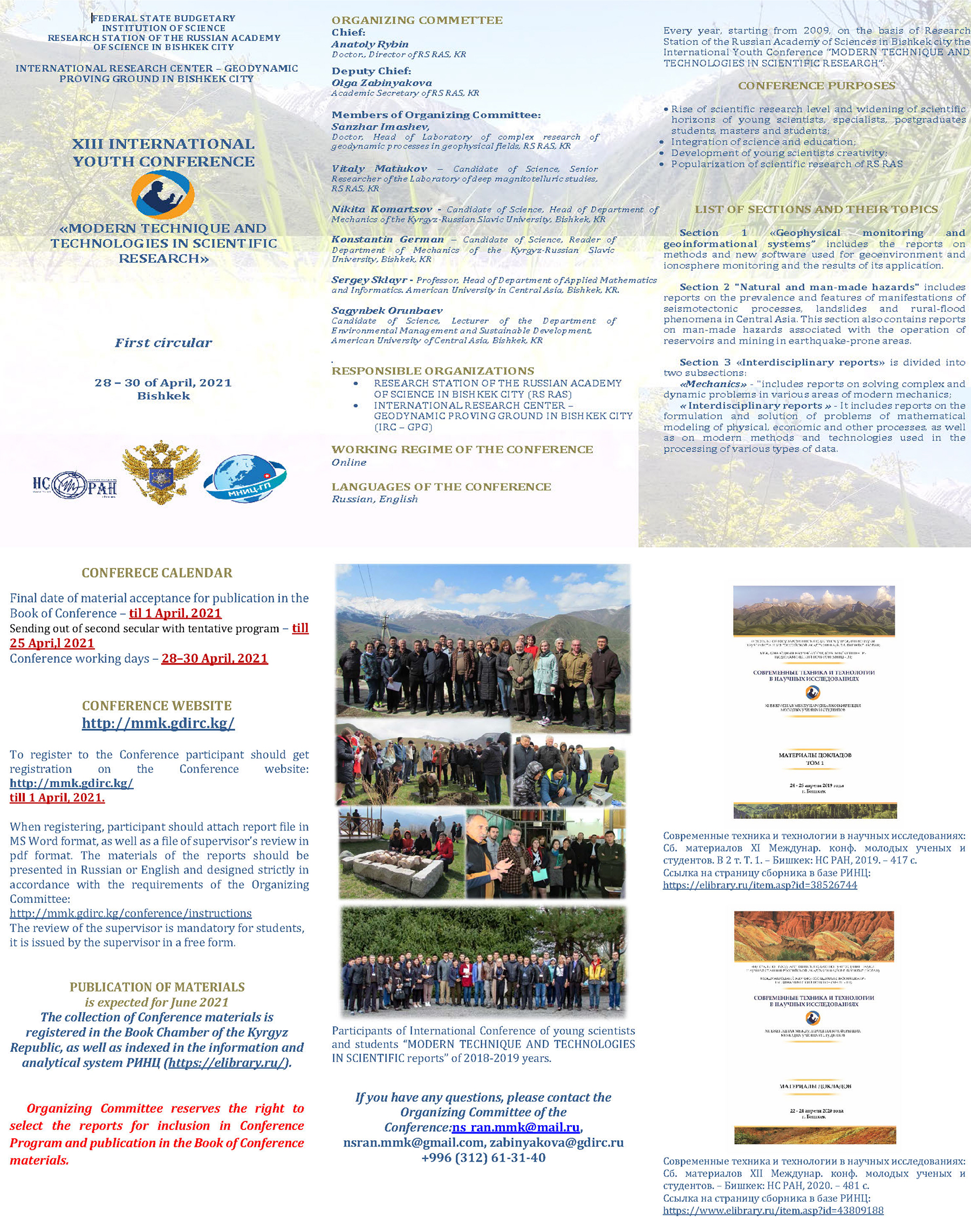
First circular_XIII International youth conference «MODERN TECHNIQUE AND TECHNOLOGIES IN SCIENTIFIC RESEARCH»
Last Updated on Friday, 19 February 2021 13:51
Results of Intellectual Activity
Thursday, 21 January 2021 14:22
Results of Intellectual Activity of RS RAS in 2021
Results of Intellectual Activity of RS RAS in 2020
Last Updated on Wednesday, 02 February 2022 15:10
VIII International Symposium
Wednesday, 20 January 2021 14:03
Dear colleagues!
VIII International Symposium «PROBLEMS OF GEODYNAMICS AND GEOECOLOGY OF INTRACONTINENTAL OROGENS» was held from 28 June to 2 July 2021 within the framework of a Year of Science and Technologies in Russia on the basis of Research Station of RAS (Bishkek city, Kyrgyz Republic).
The Organizing Committee thanks all participants of Symposium!
The contact email address is This e-mail address is being protected from spambots. You need JavaScript enabled to view it .
Please note that the Book of Abstracts is registered in the Book Chamber of the Kyrgyz Republic and will be indexed article by article in the RSCI in the fall of 2021. You can download the collection at the link:
As it was mentioned earlier, selected papers from the Symposium will be recommended for publication in a foreign edition. IOP Conference Series: Earth and Environmental Science. Personalized invitations, as well as all accompanying information, will be sent to the participants in the near future. Submission of material in the IOP Conference Series implies that you agree to the Publisher's License
(https://publishingsupport.iopscience.iop.org/questions/iop-proceedings-licence/) and familiarized with the rules of registration of materials
(https://publishingsupport.iopscience.iop.org/author-guidelines-for-conference-proceedings/).
This e-mail address is being protected from spambots. You need JavaScript enabled to view it
Dear colleagues!
We would like to remind you of VIII International Symposium «PROBLEMS OF GEODYNAMICS AND GEOECOLOGY OF INTRACONTINENTAL OROGENS» to be held from 28 June to 2 July 2021 within the framework of a Year of Science and Technologies in Russia on the basis of Research Station of RAS (Bishkek city, Kyrgyz Republic).
Symposium format: online
More information on Symposium you can find by the reference below:
Please, take a note, that following numerous applications of participants the Organizing Committee took a decision on prolongation of deadline for application and reports submitting to 25 April, 2021.
Первый циркуляр_VIII Симпозиум НС РАН 2021
Требования к оформлению тезисов
Dear colleagues!
We are glad to inform you that VIII International Symposium “PROBLEMS OF GEODYNAMICS AND GEOECOLOGY of INTRACONTINENTAL OROGENS” will be held from 28 of June to 2 of July, 2021, on the basis of Research Station RAS in Bishkek city, Kyrgyz Republic.
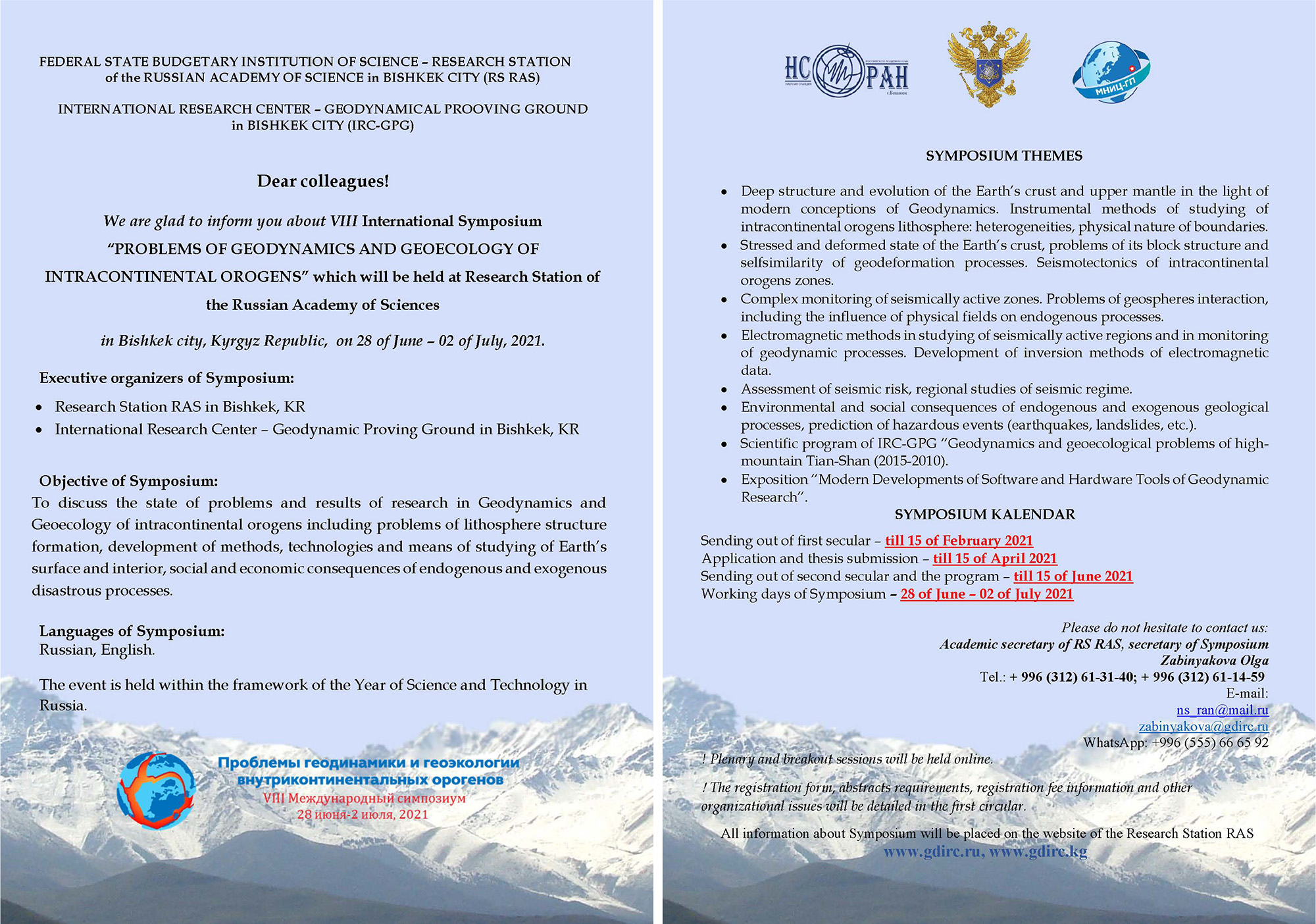
First newsletter with the theme of the event and a preliminary schedule
First Circular
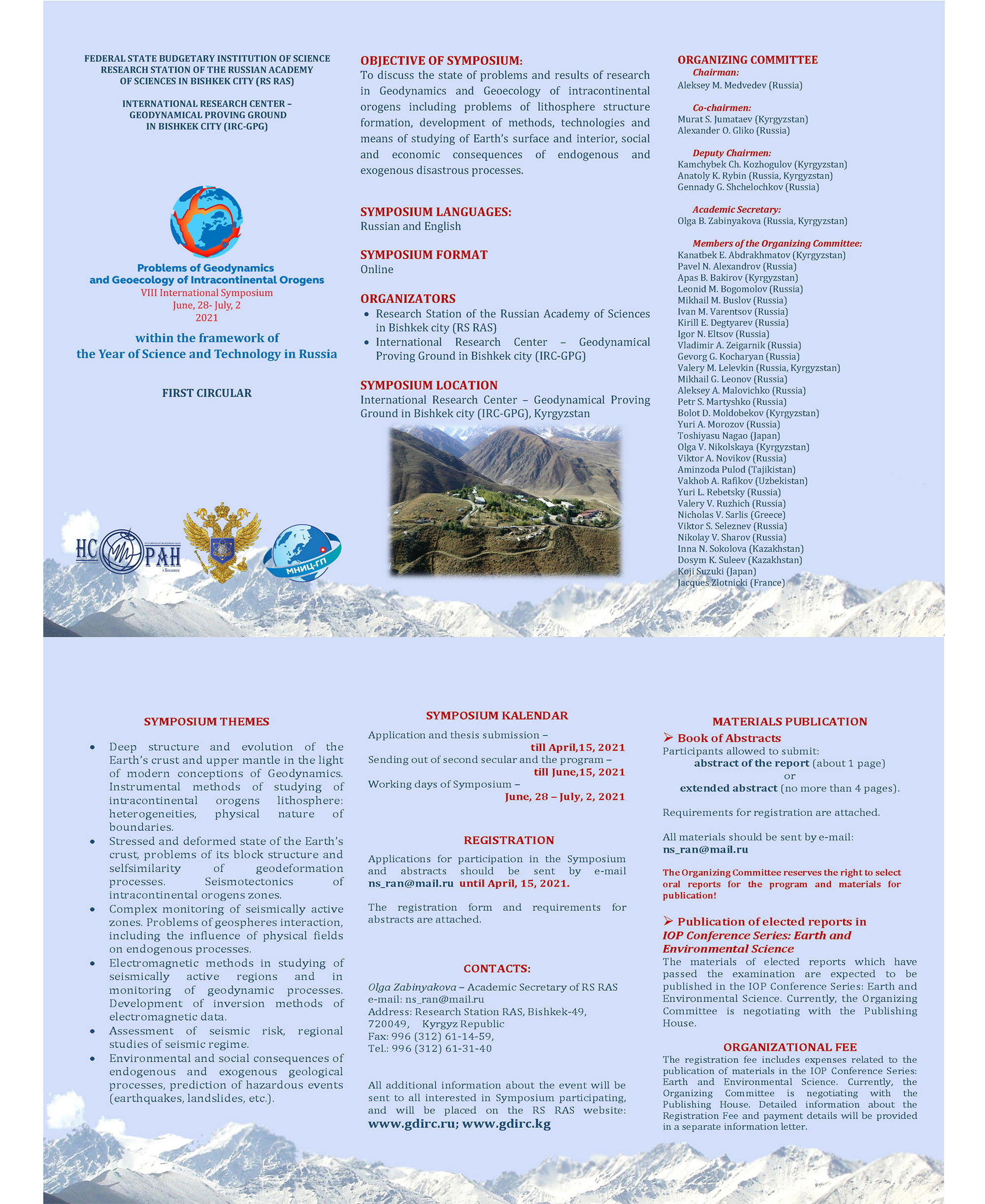
VIII International Symposium_First Circular
Last Updated on Monday, 12 July 2021 15:15
Main results of 2020
Wednesday, 30 December 2020 14:08
According to the complex of geological and seismological data on the northern slope of the Kyrgyz ridge (Tien Shan, the Sokuluk-Kegety interfluve), the area with increased values of signs of seismic hazard was identified.
In this area, each cell in longitude and latitude 0.25°×0.25° contains up to 360 earthquakes K>6 according to the KNET network data for 1994-2019. This number of earthquakes here is 2-10 times more than seismic events in the cells around. Also in this area there is a high density of faults with increased values of normalized Coulomb stresses and a high probability of their reactivation. According to geological and geodetic data and solutions of focal mechanisms, these faults have thrust and strike-slip kinematics, which indicates the concentration of matter. There are no earthquakes here with a significant level of stress relief as in the area around, which also indicates an increased level of seismic hazard for the selected area.
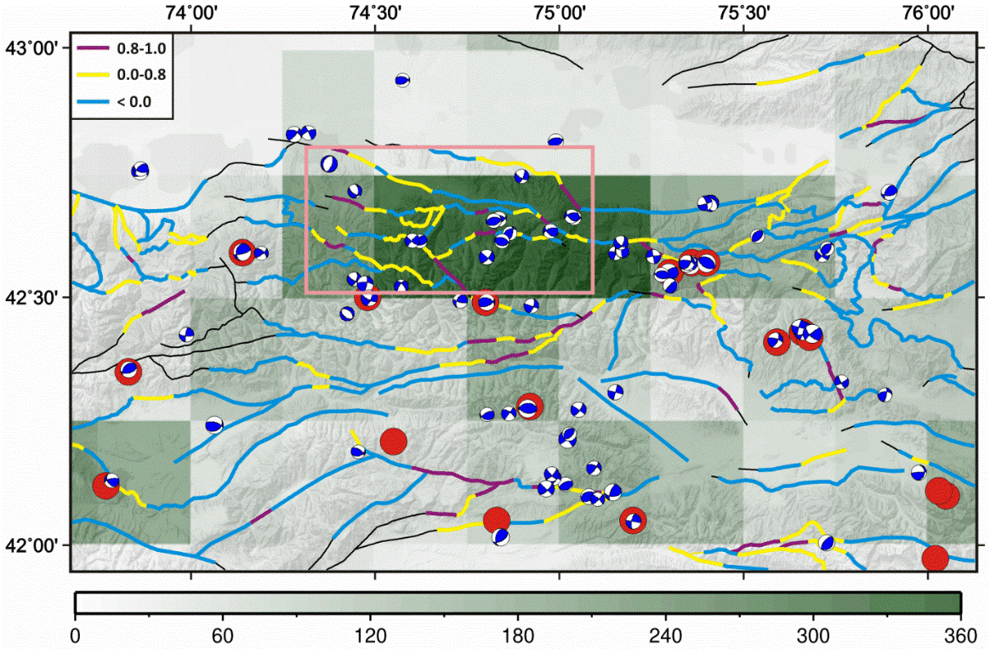
Figure. Zoning of faults by the magnitude of normalized Coulomb stresses [Rebetsky and Kuzikov, 2016] against the background of the distribution of the number of earthquakes (1994–2019) over the cells ≈20×28 km sq. (0.25°×0.25°). The focal mechanisms of earthquakes with K≥10 are marked in blue. Earthquakes with stress dropped Δσ≥10 MPa are shown as red circles. The pink rectangle is a seismically hazardous area (≈64×30 km sq.).
Last Updated on Tuesday, 19 January 2021 14:47
Laboratory of Geophysics
Thursday, 24 December 2020 14:12
We’d like to draw your attention to the web page of the LABORATORY OF GEOPHYSICS on the website of the Research Station of RAS, where all relevant information on RS RAS activity within the framework of Laboratory functioning will be published.
Recall that on September 30, 2020, KNU Rector of the Kyrgyz National University Kanat Sadykov and RS RAS Director Dr. Anatoly Rybin signed an Agreement on Laboratory of Geofisics opening on the basis of the Department of Electronics and Theoretical Physics of the Faculty of Physics and Electronics of KNU. (additional Agreement of 30. 09. 2020 to the Agreement on scientific and technical cooperation between RS RAS and KNU of 23. 03.2018).
Last Updated on Thursday, 24 December 2020 14:25
International Jubilee Conference, dedicated to 40th Anniversary from the foundation of Research Station RAS in Bishkek city
Thursday, 10 December 2020 09:59
Dear colleagues!
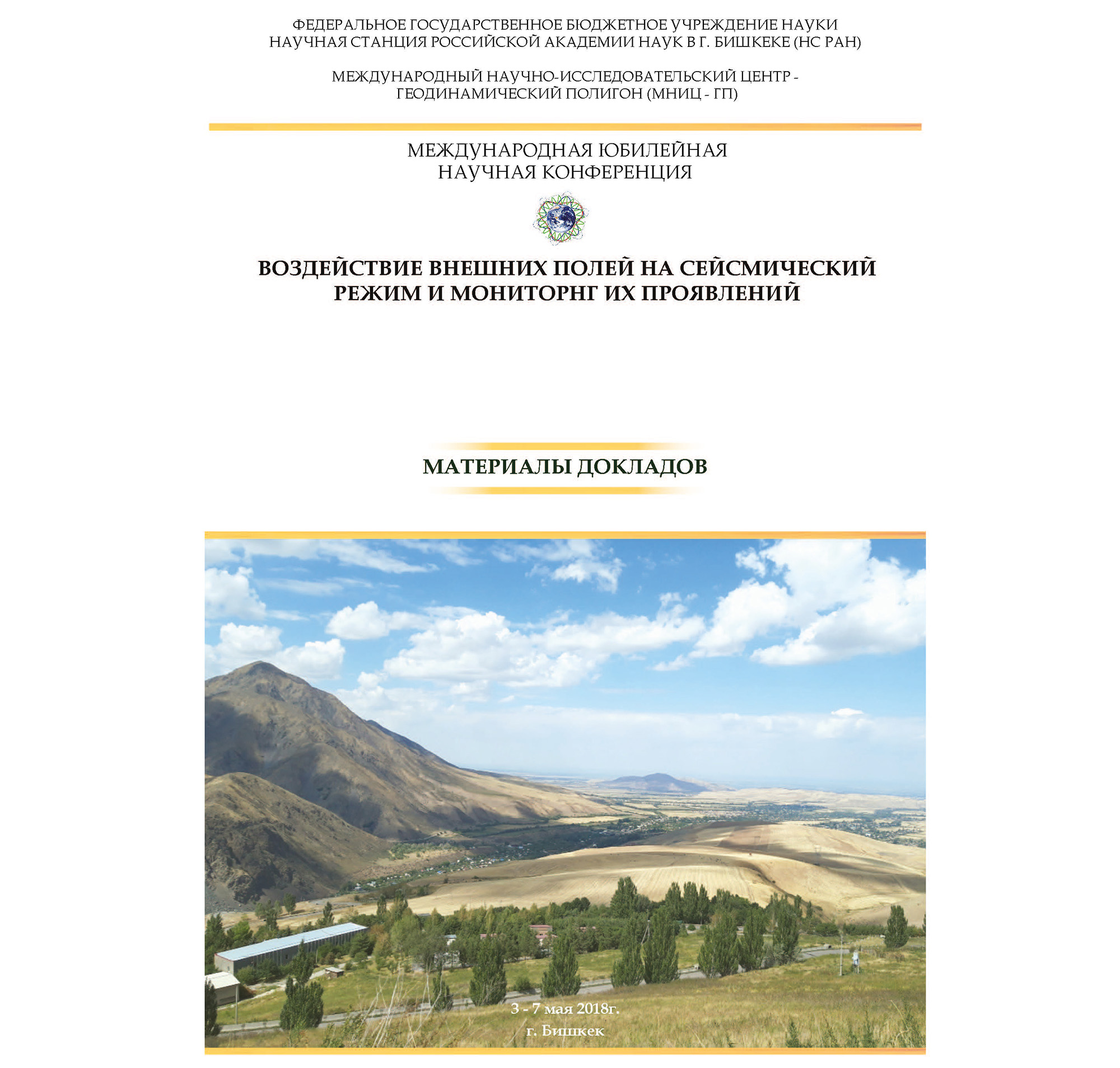
The Research Station of RAS in Bishkek city (RS RAS) pleased to announce the publication the Book of Reports of International Jubilee Scientific Conference, which was held on the base of RS RAS in 2018:
Last Updated on Friday, 11 December 2020 14:23
The election of Director of the Federal State Budgetary Institution of Science Research Station of the Russian Academy of Sciences in Bishkek city (RS RAS)
Wednesday, 04 November 2020 14:29
On October 28, 2020, the General Meeting of Employees of RS RAS was held. The main issue on the agenda was the election of Director of RS RAS.
The election procedure was carried out in accordance with the RS RAS Charter and the Regulation on the procedure for the Director election of RS RAS
Earlier, by Order of the Ministry of Science and Higher Education of Russia No. 386-p of October 19, 2020, two candidates were approved for the post of director of RS RAS:
1) Dr. Pavel ALEXANDROV;
2) Dr. Anatoly RYBIN.
Olga Zabinyakova, Scientific Secretary of RS RAS, was elected as a Chairman of the General Meeting of Employees. Also, by RS RAS order, the Election Commission was appointed, which was headed by S.S., Acting Head of the Laboratory for Integrated Research of Geodynamic Processes in Geophysical Fields, candidate of Physics and Mathematics Sanzhar Imashev.
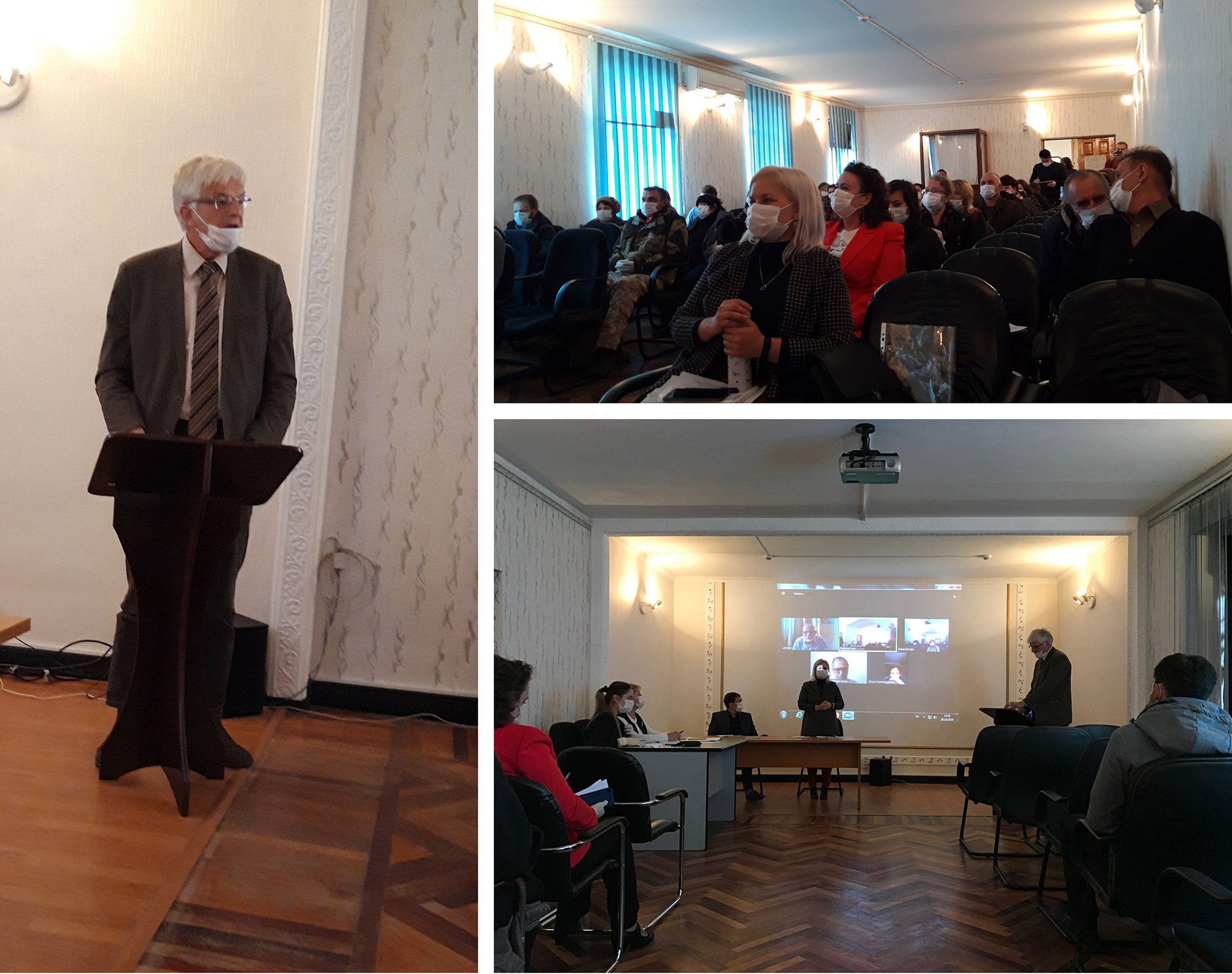
The total number of RS RAS staff members included in the voting list was 137 people. The number of registered election participants was 109 people, including 2 employees of the Representative Office of the RS RAS in the Russian Federation who voted by e-mail (quorum was observed).
Both candidates presented their election program, including the development program of RS RAS for 2020-2025 years. After that, a debate took place during which RS RAS employees had the opportunity to ask questions to candidates and speak out in support of one of them.
A secret ballot procedure was held, after which members of the Election Commission voiced the election results: 29 votes for candidate Pavel ALEXANDROV, 79 votes for candidate Anatoly RYBIN. Thus, the vast majority of votes was casted for Anatoly RYBIN.
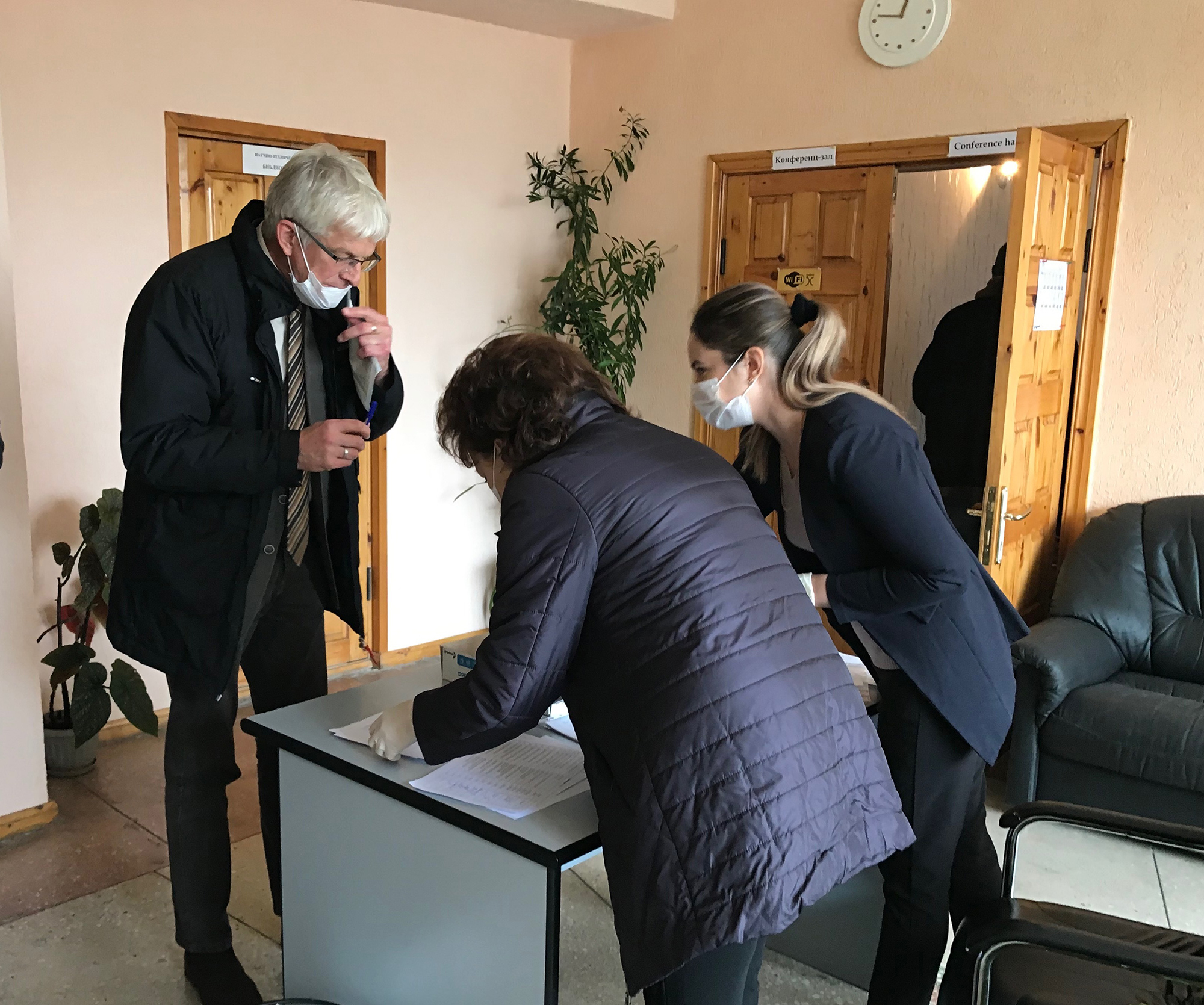
Congratulations to Dr. Anatoly Rybin on his victory in the elections for the post of Director of the Research Station of the Russian Academy of Sciences in Bishkek city!
Management and staff of the Kyrgyz National University named after Zh. Balasagyn congratulate Dr. Anatoly Rybin with contested victory for the post of RS RAS Director!
Congratulating letter you can see here
Last Updated on Wednesday, 04 November 2020 14:51
GMTS News
Tuesday, 03 November 2020 10:41
From 23 September to 07 October 2020, in continuation of monitoring observations carried out since 2012 on the territory of the Bishkek geodynamic test site, along the "East" and "Centr" profiles of the Kentor using the Phoenix MTU-5 measuring complexes, by the MTS group consisting of three teams, MT-soundings were performed at 30 points of the Centr (C1-C4, C6-C11) and «East» (E1-E11, E13-E21) profiles.
The beginning of the work was preceded by the calibration of the recorders and sensors of the MT stations. At all observation points, a control record of at least 40 minutes was preceded to assess the level of interference and adjust the parameters of recording the working record. The electric components of the MT-field were measured using measuring devices with electric dipoles 50 m long. Magnetic field components were measured with using of MTC-50 induction sensors. The dipoles were earthed by nonpolarizable electrodes by the “electrode to electrode” principle with previous observations at all sounding sites. The orientations of the measurement setups completely repeated the previous deployments. The duration of the MT-field registration at each observation point was 15-16 hours.
In the period from 23 September to 02 October 2020, the brigade № 3 of the MTS group carried out work on magnetotelluric sounding (MTS) on the "Boom" profile, located in the area of the Zholbulak village, Kemin district. The number of observation points was 9 (FT1 - FT9). The work was carried out with a Phoenix MTU-5 station in the regular registration mode. The beginning of the work was preceded by the calibration of the recorder and sensors of the MT station. Duration of registration of the MT-field at each registration point is more than 14 hours. Upon completion of work on this profile, the team from 02 October to 07 October 2020, together with two teams of the group, continued to perform work on the "East" profile of the Kentor.
.jpg)
Last Updated on Tuesday, 03 November 2020 10:45
More Articles...
Page 15 of 29
Last news
- Participation of RS RAS Researchers in the 12th Tianshan International Symposium on Earthquake Sciences in Urumqi, China
- The 10th International Symposium dedicated to the 150th anniversary of geological research in the Tien Shan, August 12–15, 2026. (Theses and materials of the Symposium)
- Resolution of Х International Symposium dedicated to 150th Anniversary of Geological Research in the Tien Shan
- News of Electromagnetic Observations Group of the Laboratory for Multidisciplinary Research of RS RAS
- X International Symposium dedicated to the 150th Anniversary of geological research of the Tien Shan
Projects
Scientific divisions
Science
Photogallery


